Empowering Aquatic Research & Ecosystem Studies with Autonomous Robotics
Academic institutions, limnologists, marine scientists, and environmental research laboratories require high-frequency, spatially explicit data to model aquatic ecosystems, study climate impact, and track waterborne pollutants. Traditional field research relying on crewed research vessels or fixed monitoring stations often suffers from high operational costs, coarse spatial resolution, and data gaps in hazardous or shallow environments.
Deploying L4 autonomous water quality monitoring vessels and surface remediation platforms provides researchers with a versatile, high-precision instrument for continuous environmental sensing, automated physical water sampling, and ecological data mapping across lakes, reservoirs, and coastal estuaries.
Primary Challenges in Aquatic Field Research
-
High Cost & Coarse Spatial Resolution: Chartering research boats with dedicated crews is expensive, limiting field campaigns to sparse temporal intervals and fixed sampling points.
-
Inaccessible & Fragile Study Zones: Shallow mudflats, dense macrophyte zones, and covered bridge channels are often inaccessible to heavy research vessels or risk habitat damage.
-
Sample Contamination & Inconsistency: Manual water sampling across variable weather conditions introduces human error, inconsistent depths, and delays in sample preservation.
-
Lack of Adaptive Sampling: Static sensors fail to detect localized pollution plumes or transient algal bloom dynamics that require immediate, targeted physical sampling.
Autonomous Robotic Capabilities for Research Applications
1. High-Precision Environmental Sensing & Physical Sampling
-
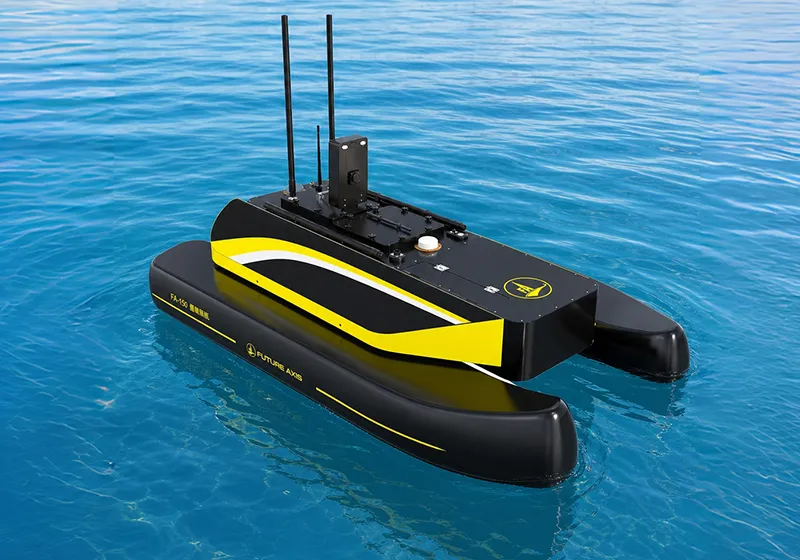
Multi-Parameter Sensor Array: Delivers continuous, synchronized telemetry on critical limnological indicators, including pH, dissolved oxygen (DO), turbidity, conductivity, salinity, ORP, chlorophyll-a, blue-green algae, and ammonia nitrogen.
-
GPS-Anchored Peristaltic Sampling: Integrated multi-bottle peristaltic pumping systems pull physical water samples at exact GPS coordinates and specified depths when sensor anomalies are triggered, preserving sample integrity for lab analysis.
-
High-Accuracy RTK-GNSS & IMU Navigation: Dual-antenna RTK-GNSS paired with onboard Inertial Navigation Systems (IMU) guarantees sub-centimeter positioning accuracy and stable track-line navigation along transects, even under bridges or dense canopies.
2. Autonomous Surface Cleaning & Experimental Control
-
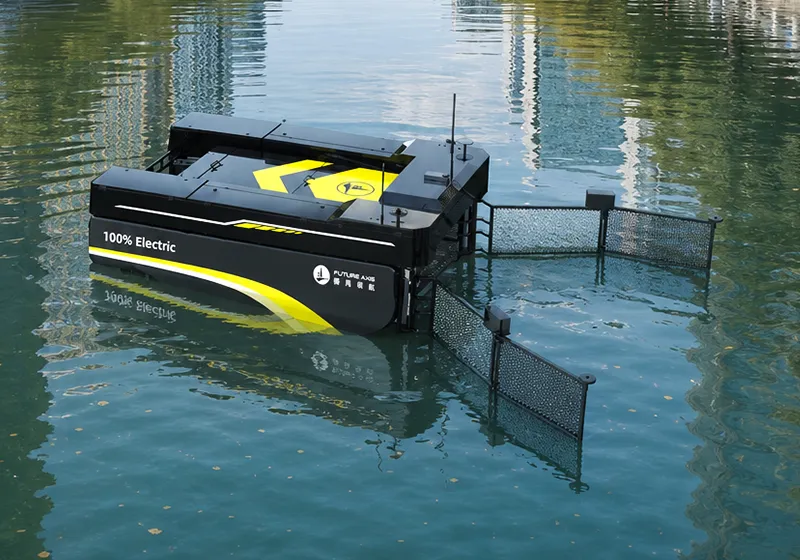
Targeted Surface Biomass Interception: Autonomous cleaning vessels can clear floating duckweed, filamentous algae, and macro-plastics from experimental enclosures or specific study transects.
-
Heavy Payload & Swath Capability: Handles up to 100 kg of surface material per run with dynamic expandable arms extending sweep coverage up to 2.8 meters.
-
Pure Electric & Low-Impact Operations: Quiet electric propulsion ensures zero exhaust contamination or chemical interference with delicate biochemical measurements.
Strategic Value for Research Institutes
-
Dense Spatiotemporal Datasets: Enables continuous transect mapping and 24/7 autonomous monitoring, transforming discrete point data into high-resolution spatial models.
-
Up to 75% Reduction in Field Costs: Minimizes reliance on crewed vessel rentals and manual field teams, allowing research grants to stretch further.
-
Open Cloud Telemetry & API Integration: Real-time data streams via 4G/LTE directly into laboratory information management systems (LIMS) and GIS mapping software.
WELCOME TO FA
We focus on every single detail. OEM & ODM high-end quality products for the international brands.
 All Scenarios